
Why Post-Storm Roof Inspection Is Critical for Northern Virginia Homeowners
A post-storm roof inspection is essential to identify hidden damage, prevent costly repairs, and protect your home’s structural integrity. After severe weather passes through Northern Virginia, immediate assessment within 24-48 hours helps you catch problems before they escalate. For homeowners in the region, partnering with a trusted Northern Virginia roofing company is the first step toward securing your property from leaks, mold, or structural failure.
Quick Answer: What to Do After a Storm
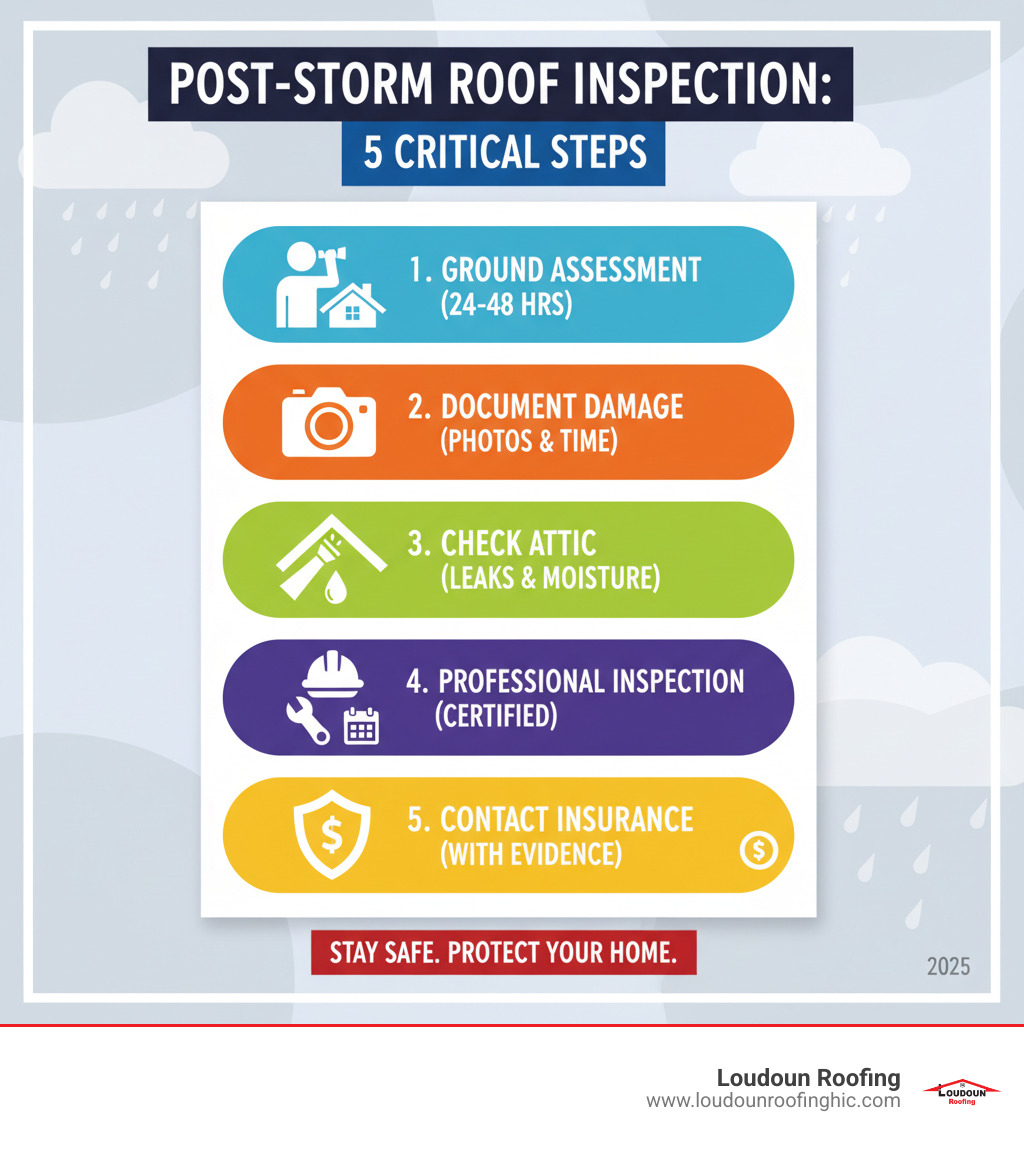
- Prioritize safety – Never climb on a damaged or wet roof
- Inspect from the ground – Look for missing shingles, debris, and gutter damage
- Document everything – Take photos and videos with timestamps
- Check your attic – Look for daylight, water stains, or wet insulation
- Call a professional – Schedule a certified inspection within 48 hours
- Contact your insurance – Report damage promptly to avoid claim complications
After a storm passes, it’s easy to assume that if your building looks fine from the ground, it has weathered the worst. However, this assumption could lead to significant and costly problems down the road. Many roofs suffer damage that isn’t immediately visible—small tears in underlayment, lifted shingles with broken seals, or hail bruising that weakens protective granules. According to recent data, hail-related losses in the U.S. exceeded $3.5 billion in 2022, with Texas leading in both frequency and cost of claims. Northern Virginia experiences its share of severe weather too, from high winds and hail to heavy rain and occasional hurricanes.
The consequences of delaying a post-storm roof inspection are severe. What starts as a minor leak can quickly deteriorate into rotted decking, compromised structural members, mold growth, and even voided warranties. Many commercial roof warranties require timely inspections and repairs after storm events. Insurance companies also favor homeowners who act quickly—delays can make it difficult to prove that damage resulted from a specific storm rather than general wear and tear.
A professional roof inspection goes far beyond what you can see from your driveway. Certified inspectors use advanced tools, including moisture meters and sometimes drones, to assess every component of your roofing system. They check shingles, flashing, gutters, ventilation, and the critical interior spaces like your attic where hidden water infiltration first appears. This thorough evaluation provides the documentation you need for insurance claims and ensures that all damage—obvious and subtle—gets addressed before it worsens.
My name is Esteban Marin, and I’ve been conducting post-storm roof inspections across Loudoun County since 2001. Through hundreds of assessments following severe weather events, I’ve seen how prompt, professional evaluation protects homeowners from escalating damage and insurance disputes.
First Steps After the Storm: Safety, Documentation, and Mitigation
When the wind finally stops howling and the rain tapers off, your first instinct might be to grab a ladder and check your roof. Hold that thought. The moments immediately following a storm are when smart, safe decisions matter most. Acting quickly but carefully can stop small problems from becoming expensive disasters—but only if you prioritize safety above everything else.
At Loudoun Roofing, we’ve seen too many homeowners rush into dangerous situations trying to assess damage. The ideal window for a post-storm roof inspection is within 24 to 48 hours after conditions are completely safe. Notice that key phrase: after conditions are safe. No roof is worth risking your life.
Safety and Ground-Level Assessment
Let’s be clear: wet roofs and damaged roofs are both extremely dangerous. Add ice, loose debris, or structural compromise to the mix, and you’re looking at a potential tragedy. Your safety and your family’s safety always come first. Never climb onto a roof that appears damaged, is still wet, or shows any signs of instability.
Before you even step outside, scan your property from windows for downed power lines. These are silent killers, and they’re more common after storms than most people realize. Once you’ve confirmed the area is clear, it’s time for a thorough ground-level inspection. Walk completely around your home, looking up at every angle of your roof.
Binoculars are your best friend here. They let you examine your roof in detail without ever leaving the ground. Focus on your gutters and downspouts first—are they sagging, dented, or overflowing with debris? Look for fallen shingles in your yard or stuck in bushes. Check your siding and windows for cracks or impact marks. Even seemingly minor debris on your roof can scratch away protective granules or hide punctures underneath.
A drone can provide even better visibility if you have access to one, giving you a bird’s-eye view without the risk. For comprehensive guidance on conducting a safe assessment, the experts at GAF provide excellent advice on How to Safely Inspect Your Roof After a Storm.
Documenting the Damage
Here’s where your smartphone becomes one of your most valuable tools. Documentation is the foundation of a successful insurance claim, and you can never have too much of it. Take extensive photos and videos of everything you observe, even damage that seems trivial. Insurance adjusters need evidence, and memories fade quickly.
Start with wide-angle shots that show the overall condition of your roof and property, then move in for close-ups of specific damage. Enable your camera’s timestamp and location features—this creates undeniable proof of when and where the damage occurred. Modern smartphones automatically embed this data in photo files, which insurance companies can verify.
Note the storm’s date and intensity in your documentation log. Was it straight-line winds? Golf-ball-sized hail? A brief tornado? This context matters enormously for your claim. If you find physical evidence like torn shingles, broken flashing, or chunks of hail, keep these damaged materials as evidence. Place them in a safe, dry location and photograph them with a ruler or coin for scale.
Create a detailed written log that includes dates, times, weather conditions, and descriptions of every piece of damage you find. This meticulous record becomes your timeline if questions arise later. For more information on what professional assessors look for, visit our Storm Damage Assessment page.
Temporary Protective Measures
When you find active leaks or significant damage exposing your home’s interior, immediate action prevents secondary damage that insurance may not cover. Active leak management starts with the basics: place buckets under drips to protect floors, furniture, and belongings. Move valuables away from affected areas and document water damage as it appears.
For larger compromised areas or holes in your roof, professional tarping is the only safe solution. We cannot stress this enough: avoid DIY repairs on your roof, especially in the aftermath of a storm. Climbing onto damaged roofing is extraordinarily dangerous, and improper repairs can actually void your insurance policy or manufacturer’s warranty.
Many homeowners don’t realize that insurance companies often cover the cost of emergency tarping when performed by licensed professionals. This protective measure prevents further water infiltration while you wait for permanent repairs, and it demonstrates to your insurer that you took reasonable steps to mitigate damage.
Our team provides swift, safe Emergency Roof Repair services throughout Loudoun County, including professional tarping that protects your home without putting you at risk. We understand that storm damage doesn’t wait for business hours, and neither do we.
A Homeowner’s Guide to Identifying Roof Storm Damage
Storms don’t play fair. They inflict damage in ways that range from glaringly obvious to frustratingly subtle. Understanding what to look for during your post-storm roof inspection is the difference between catching a problem early and facing a major repair bill later. According to the Insurance Information Institute, hail alone caused over $3.5 billion in losses in 2022, a sobering reminder of the financial risk that comes with unaddressed storm damage.
Even when your home looks fine from your driveway, significant damage may be hiding in plain sight. The challenge isn’t just spotting a missing shingle—it’s recognizing the less obvious signs that indicate your roof’s protective barrier has been compromised.
Wind Damage
Wind is one of nature’s most destructive forces when it comes to roofing. You don’t need a full-blown hurricane to cause serious damage—even moderate gusts can compromise your roof’s integrity. Hurricane-force winds start at 74 mph, but winds as low as 40-50 mph can lift shingles and break their seal.
After a windstorm, the first thing to look for is missing or torn shingles. High winds can rip shingles right off your roof, leaving vulnerable spots where water can penetrate. But wind damage isn’t always that dramatic. Sometimes you’ll find curled or lifted shingle edges where wind has gotten underneath and broken the adhesive seal. These lifted edges create entry points for wind-driven rain during the next storm.
Creased shingles are another telltale sign. When powerful gusts bend shingles without tearing them completely off, they create permanent creases that weaken the material and make it prone to cracking. Around chimneys, skylights, and vent pipes, check for loose flashing—those metal or rubber strips that seal joints and transitions. Wind can pry these critical components loose, and even a small gap can lead to significant leaks.
Don’t overlook debris impact marks either. Branches, patio furniture, or other projectiles carried by wind can strike your roof, causing dents, punctures, or scuffs that compromise the surface. What looks like a minor scuff might have fractured the shingle’s protective layer.
Hail Damage
Hailstorms pack an incredible punch in a short amount of time. The damage they cause is often more insidious than wind damage because it’s not always immediately visible—but it’s just as destructive.
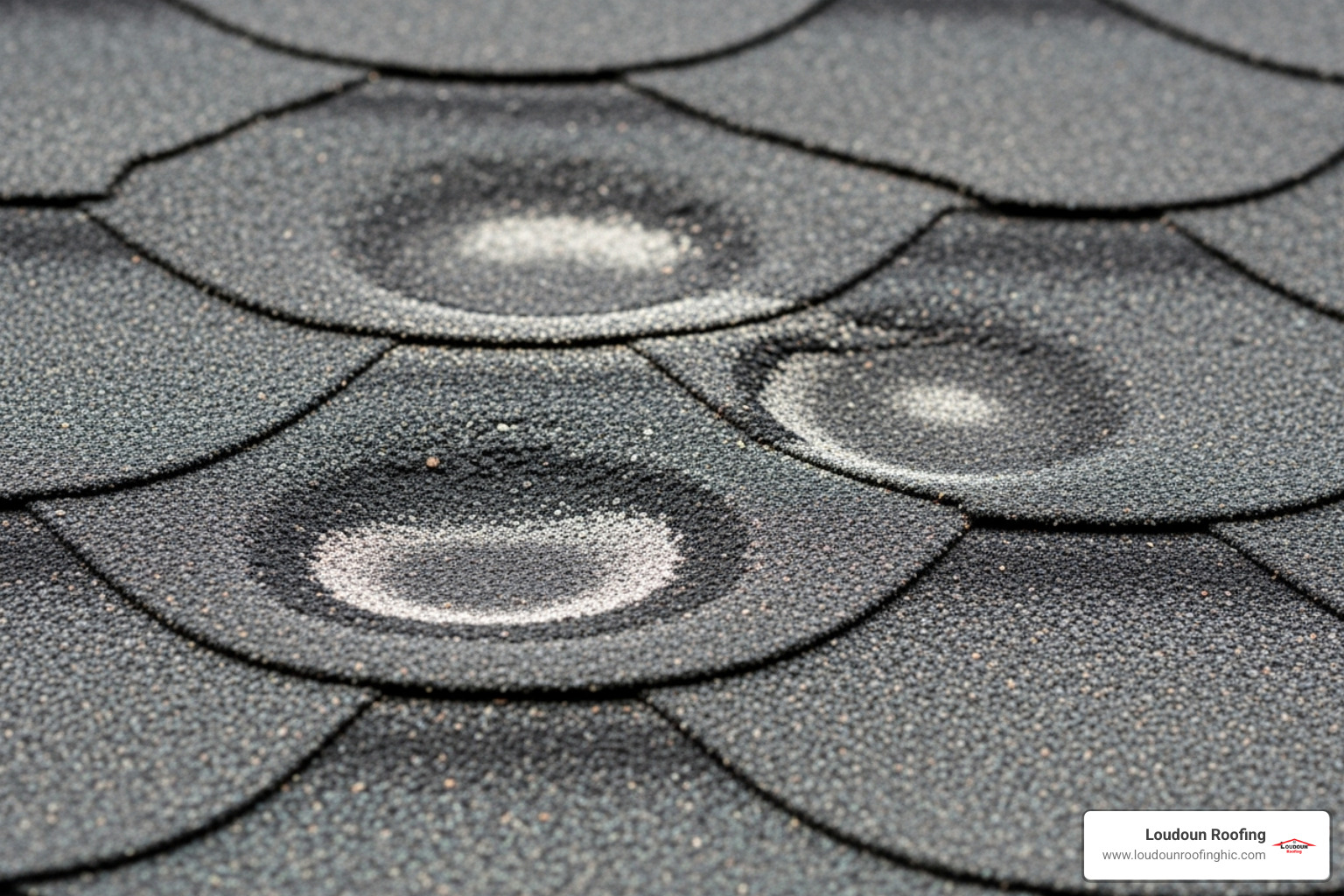
On asphalt shingles, hail creates bruises or dents that appear as circular or irregular dark spots. These aren’t just cosmetic blemishes. Each impact dislodges the protective granules that shield your shingles from UV rays and weather. Speaking of granules, if you notice what looks like coarse, gritty sand accumulating in your gutters or downspouts after a hailstorm, that’s granule loss—a clear sign your shingles took a beating. Without those granules, your shingles age much faster and become vulnerable to cracking and water infiltration.
For homes with tile or slate roofs, hail damage looks different but is equally concerning. Large hailstones can cause cracked or shattered tiles, breaking through these otherwise durable materials. Even a single cracked tile can allow water to seep through to the underlayment and decking below.
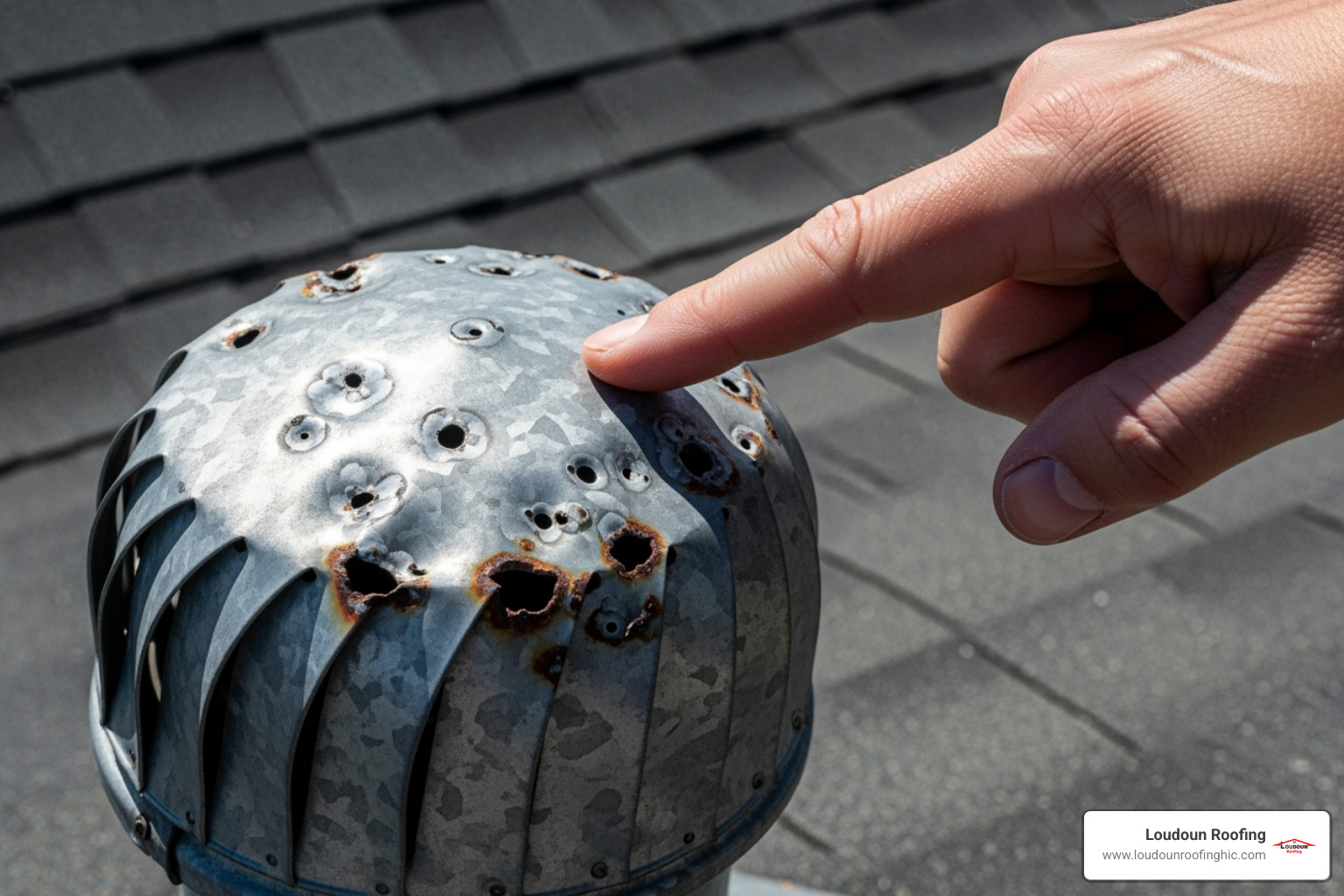
Here’s a helpful tip: check your metal components. Dents on gutters, downspouts, and flashing serve as excellent indicators that your roof likely sustained hail damage too. If your metal vent caps are dented, your shingles almost certainly are as well. For a comprehensive look at identifying this type of damage, visit our guide on Storm Hail Damage.
Water and Debris Damage
Water is relentless. Give it even the tiniest opening, and it will find its way into your home, causing damage that spreads far beyond the initial breach.
Water stains on ceilings are the most obvious interior sign of a roof leak. These yellow, brown, or rust-colored spots can appear directly below the leak or spread across a larger area as water travels along roof decking or rafters. If you notice sagging drywall, the situation is already serious—water has saturated the material, softening it and creating a structural hazard that needs immediate attention.
Sometimes your nose knows before your eyes do. A persistent musty odor in the attic signals hidden moisture, which creates the perfect environment for mold and mildew. This isn’t just a roof problem—it’s a health concern.
Clogged gutters might not seem like roof damage, but they cause it. When storms fill gutters with leaves, twigs, and shingle granules, water can’t drain properly. Instead, it backs up under shingles or seeps into fascia boards, causing rot and water damage around your roofline. During heavy storms, overflowing gutters can even compromise your home’s foundation.
Fallen branches create obvious punctures, but they also leave behind scuffs and cracks that are easy to miss. These seemingly minor surface damages can compromise your roof’s waterproof barrier, creating weak points where future storms will exploit. Our team at Loudoun Roofing has seen countless cases where a small crack ignored today became a major leak six months later. If you’re dealing with active leaks, our Roof Leak Repair McLean services extend throughout Northern Virginia.
The Critical Role of the Attic Inspection
Your attic tells the story that your roof’s exterior might be hiding. A thorough post-storm roof inspection absolutely must include checking this critical space, where early warning signs of damage first appear.
Stand in your attic during daylight hours and look up. Can you see daylight visible through roof boards? Any light filtering through your decking means you have a breach—a direct pathway for water to enter. Check your insulation next. Wet insulation is compressed, heavy, and darker than dry material. It’s not just ineffective at this point—it’s also a breeding ground for mold.
Look closely at the underside of your roof decking for dark streaks or stains on plywood. These discolorations indicate past or present leaks, even if you haven’t noticed water inside your living spaces yet. In severe cases, prolonged water infiltration causes the roof deck itself to weaken, resulting in a sagging roof deck—a serious structural problem that demands immediate professional intervention.
A word of caution: attics can be hazardous, especially after a storm. Watch your footing on joists, use a strong flashlight, and be mindful of exposed nails and electrical wiring. If you’re uncomfortable venturing up there, or if you spot any of these warning signs, it’s time to call in the professionals. This internal inspection is what transforms a basic visual check into a complete, comprehensive assessment of your roof’s true condition.
The Professional Post-Storm Roof Inspection and Insurance Process
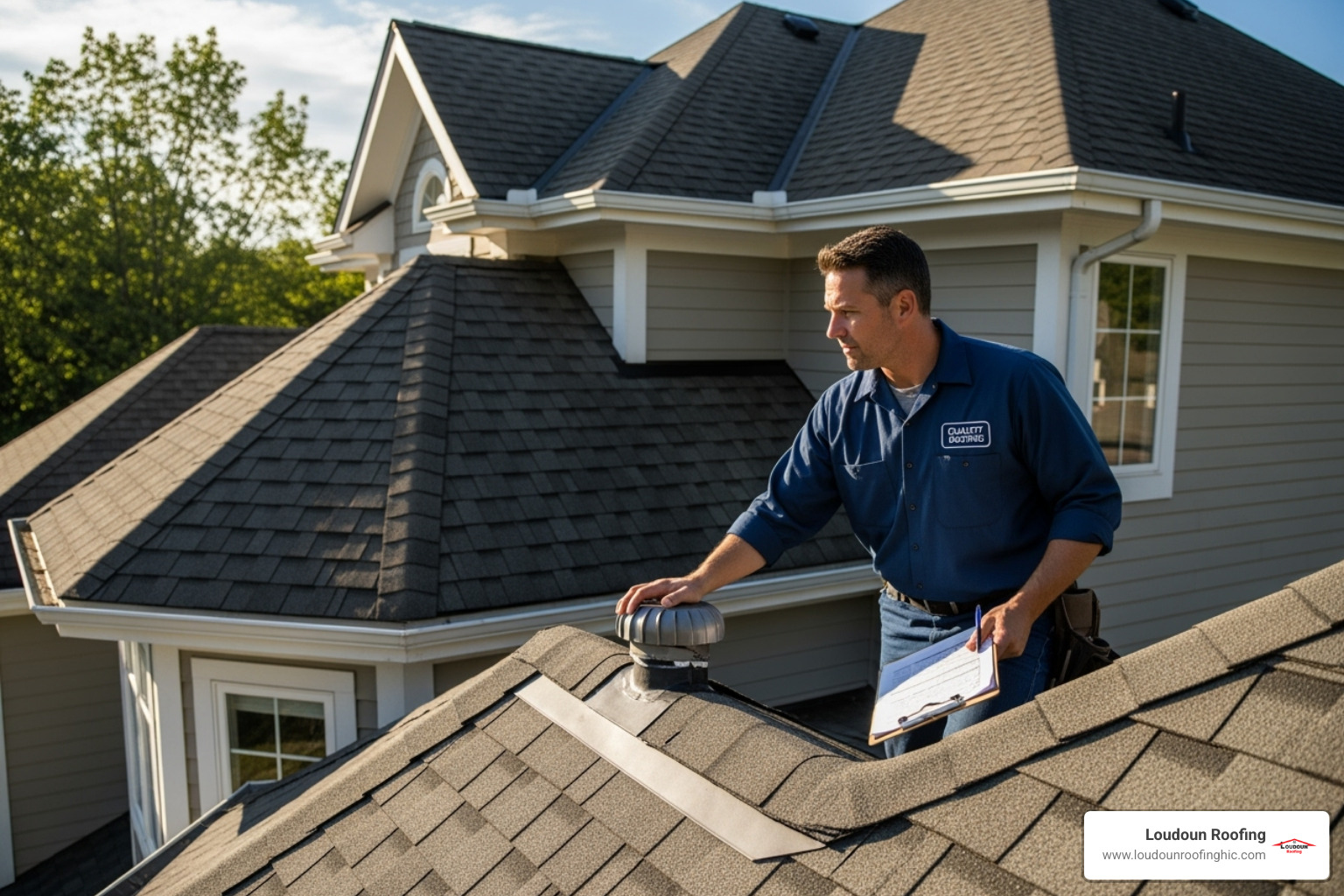
Your ground-level assessment is a smart first move, but it’s just the beginning. A post-storm roof inspection by a certified professional is absolutely essential for uncovering damage that even the keenest homeowner’s eye will miss. Insurance companies need more than photos from your drivewaythey require detailed, expert documentation from a qualified inspector. This is where partnering with a trusted Leesburg roofing contractor makes all the difference between a smooth claim and a frustrating denial.
What to Expect During a Professional Inspection
When you schedule a professional inspection with our team at Loudoun Roofing, you’re getting far more than a quick glance. We conduct a comprehensive exterior evaluation that covers every component of your roofing systemfrom the ridge cap down to the gutters. Our certified inspectors examine shingles for subtle bruising and granule loss, check flashing around chimneys and vents for loosening, and assess skylights and penetrations where leaks often hide.
We don’t stop at the surface. A detailed attic and interior check is crucial for identifying hidden water infiltration that hasn’t yet shown up as a ceiling stain. We look for daylight peeking through roof boards, wet or compressed insulation, dark streaks on plywood, and any signs of structural sagging. These interior clues often reveal damage that’s invisible from the outside.
Our assessment of all roof components is methodical and thorough. Every vent, every piece of flashing, every transition point gets scrutinized. We use moisture detection tools like infrared cameras and moisture meters to find trapped water within your roof structure before it causes major rot or mold. This technology reveals problems that would otherwise go unnoticed for months.
You’ll receive a written report with photos that clearly documents every issue we find. This isn’t a vague summaryit’s a detailed, organized report with time-stamped photographs, marked locations, and clear explanations of each problem. We also provide repair or replacement recommendations with honest, straightforward guidance on what needs immediate attention and what can wait. Our goal is to give you a complete picture of your roof’s condition so you can make informed decisions.
For a thorough evaluation that leaves nothing to chance, explore our Certified Roof Inspections McLean VA services.
How a Professional Inspection Aids Your Insurance Claim
Dealing with insurance claims after storm damage can feel overwhelming, especially when you’re already stressed about potential repairs. A professional post-storm roof inspection is your strongest ally in securing fair compensation.
The expert documentation we provide serves as credible, objective proof that insurance adjusters take seriously. Our reports establish a clear timeline and scope of damage, making it much harder for insurance companies to dispute your claim. We’ve seen countless cases where homeowners with professional documentation received full coverage, while those relying only on their own photos faced pushback or partial denials.
An accurate damage scope is critical because insurance adjusters, while trained, may miss subtle issues like compromised underlayment or granule loss that will shorten your roof’s lifespan. Our comprehensive reports ensure that nothing gets overlooked, which directly affects the settlement amount. This thoroughness prevents claim denial by demonstrating that you acted responsibly and that the damage is legitimate and storm-related.
We can arrange for your contractor to meet with the adjuster during their inspection. Having our expert on-site ensures that all damage points are clearly communicated and nothing gets minimized or dismissed. This collaborative approach often maximizes your settlement because both parties are looking at the same evidence with the same level of detail.
There’s another critical reason for prompt professional inspection: your roof warranty. Most manufacturers require timely action after storm events to maintain coverage. Neglecting an inspection and subsequent repairs can void your warranty entirely, leaving you financially exposed. Our documentation helps you stay compliant with warranty requirements while also providing the evidence your insurance company needs.
For guidance on navigating the claims process from start to finish, visit our page on Roof Insurance Claims Explained.
Differentiating Damage on Various Roof Types
Storm damage doesn’t look the same on every roof. Understanding how different materials respond to severe weather helps you know what to look for and what to expect during repairs.
| Roof Type | Common Storm Damage Signs | Learn More |
|---|---|---|
| Asphalt Shingle | Missing or torn shingles, granule loss in gutters, bruising or circular dents, lifted or curled edges, creased shingles | Asphalt Shingle Roofs |
| Metal | Dents from hail impact, scratches or scuffs from debris, loosened fasteners or panels, compromised seams or flashing | Metal Roofing Loudoun County |
| Tile/Slate | Cracked or shattered tiles, displaced or slipped tiles, broken edges or corners, damage to underlayment beneath tiles | Roof Tile Replacement Complete Guide |
Asphalt shingle roofs show damage through granule loss, which appears as dark spots on shingles or sandy accumulation in gutters. Wind creates telltale patterns of missing or lifted shingles, while hail leaves circular bruises that compromise the protective layer. These roofs are the most common in Northern Virginia, and storm damage, if caught early, is often repairable without full replacement.
Metal roofs are incredibly durable but not invincible. Hail leaves visible dents on panels and around vents, and flying debris can scratch or scuff the protective coating. While these cosmetic issues may not immediately cause leaks, they can accelerate corrosion. Loosened fasteners or panels are more serious, creating pathways for water infiltration. For more on maintaining and repairing metal systems, see our guide on Metal Roofing Loudoun County.
Tile and slate roofs are beautiful and long-lasting, but they’re brittle. Large hail or falling branches can crack or shatter individual tiles, and strong winds can displace them entirely. Because each tile overlaps, damage to one can affect the watertight seal of several surrounding tiles. Repairs require careful matching and skilled installation to maintain both function and appearance. Learn more about these premium roofing systems in our Roof Tile Replacement Complete Guide.
Understanding your roof type helps you communicate effectively with both your inspector and your insurance adjuster, ensuring that damage assessments and repair estimates are accurate and appropriate for your specific roofing system.